
Yes, moissanite jewelry can be developed for sale under your own brand. But private label moissanite jewelry can mean several things: a selected style with your card and box, a small change to an existing piece, or a new piece made from your drawing. Decide which one you mean before asking for a price. The work behind each option is different.
Start with the style you want to sell and show where your brand should appear. Then ask what can change on that piece, what needs a sample, and how quantities affect the quote. A logo file alone cannot answer those questions.
Start with an existing style or your own design
If a current style is close to your idea, send its product photo or reference number. Say whether you want the jewelry itself as shown or want to change the stone, finish, size range, chain, setting or other detail. Ask which of those changes can be made to that specific style.
Starting with an existing style can shorten development when its construction stays the same. A different ring setting or pendant structure may still need design and sampling work. A branded card may be simpler than putting a logo on the metal. Ask for a sample plan and timing based on the changes you actually want.
If the design is yours, send a drawing, CAD file or marked reference images. Identify what must stay as drawn and what you want help developing. The OEM, ODM and private label comparison explains the working routes; here, the aim is one approved product and one agreed brand presentation.
Decide where your brand will appear
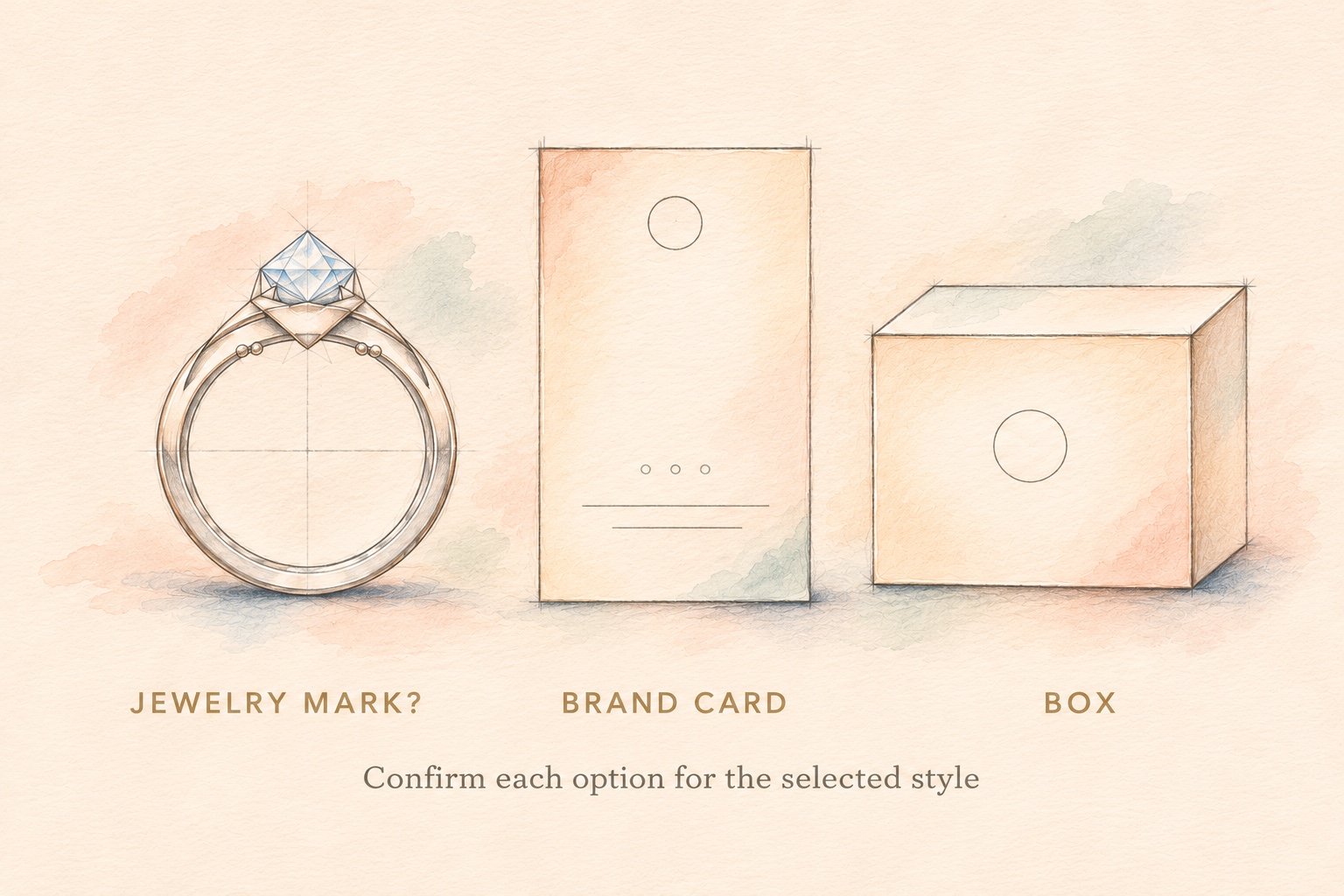
“Add our logo” needs a location. Is it on the jewelry, a display card, a pouch, a box, a care card, a label, or several of these? Send the artwork and identify the placement for each item. If you want a mark on a small ring or earring, ask to review its size and legibility on the sample before treating it as available for the order.
Packaging decisions can affect the sample and quote too. A ring box, necklace card and barcode label solve different problems. Tell the supplier how the product will be sold and shipped, then agree the pack-out for each style. Do not assume a stock box will fit every pendant or pair of earrings.
Keep the jewelry and packaging approvals together. A ring may be correct while its branded card has the wrong color, wording or placement. Review both before the production version is fixed.
Approve the piece, not just the branding
For every private label piece, check the jewelry itself. Identify the moissanite shape and dimensions in millimeters, then confirm the metal, setting, finish, product dimensions and sizes. If the piece uses 925 sterling silver, state that as the base metal; a silver-colored photograph cannot establish the metal. Our moissanite and 925 silver guide covers those product details in more depth.
Look at the sample from the side and back, and wear it if fit matters. Check that the stone sits as intended, the clasp or backing works, and the finish matches the agreed look. Record any change against the sample version. COINA's moissanite and sterling silver ring samples can help start that discussion, but an existing sample does not prove that every proposed alteration is available. Our ring sampling article shows the review points for a custom ring.
Describe moissanite accurately in your own listing
The brand name on the box does not change the identity of the stone. Moissanite is silicon carbide and is different from diamond, as GIA explains. Name the stone as moissanite in your product information. A thermal diamond tester is not proof that it is a diamond; the US FTC notes that such testers may misidentify moissanite. Check the product claims required in the market where you will sell.
If you plan to make claims about a certificate, metal content, plating or wear resistance, check the evidence for the actual product before adding them to cards or listings. Your packaging copy should match the approved specification, not a generic description reused across several styles.
What should you send for a private label quote?
One short message can cover the first decision:
- The style photo or your own drawing, with a note on what you want to keep or change.
- The product category, stone shape and dimensions, metal, finish and sizes if known.
- Your logo artwork and the exact places you want it considered.
- Your card, pouch, box and label direction, including any existing artwork.
- Expected quantities by style, color and size, plus the market where you will sell.
- Your target launch window and the decisions you need the sample to settle.
Leave unknown details marked as questions. For a selected style, say if you are happy with the current construction; this may keep the development discussion shorter. For a new design, list the parts that must be approved before production. Our guide to starting from your design or an existing style can help you choose the right starting point.
To discuss a COINA project, send us the style or design, branding requirements and expected quantities. We can review which parts belong in the sample, which branding options need checking, and what should be included in your quote.
Ready to discuss your collection?
Share what you know so far. A simple idea is enough to start.
Send your brief to COINA ↗